

News & Tutorial

To Provide You With The Latest Product Information And Company News

Do you know your Internet Explorer is out of date?

To get the best experience for our site, we recommend you upgrade to the latest version of Internet Explorer, or select another web browser, a list of the most popular web browsers can be found below

You can download the main browser here:

Position : Home> News & Tutorial >Products

Unleashing the Full Potential: How 800G Optical Transceiver is Revolutionizing AI?

Date: 2026-08-21 16:00:41

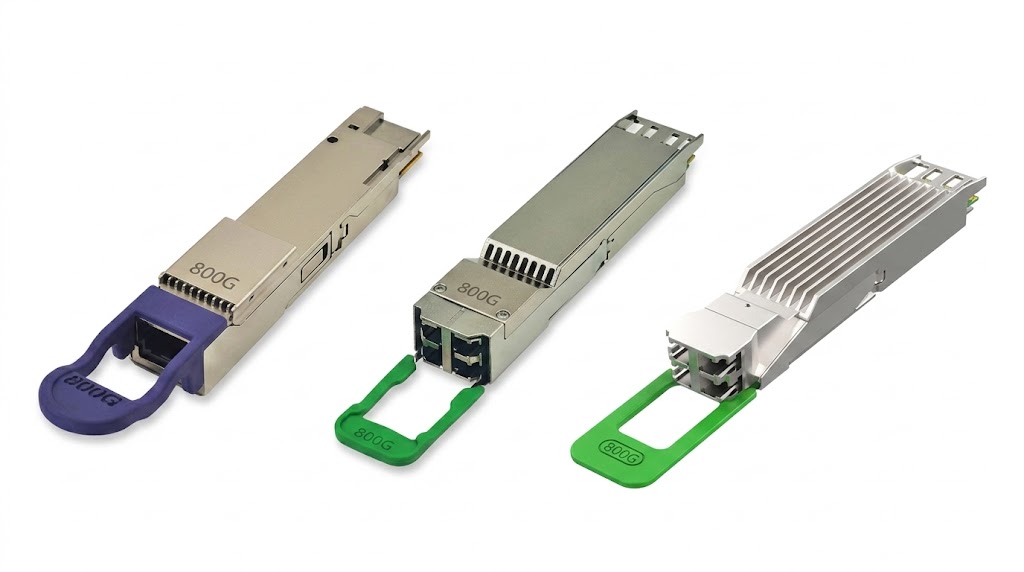
With the rapid development of AI (Artificial Intelligence), the demand for high-speed data transmission has become more critical than ever. 800G optical transceiver is a crucial solution for meeting this demand. This article presents the evolution of 800 optical transceivers and their potential in AI.

\
 

What is an 800G Optical Transceiver?
An 800G optical transceiver is a device that supports data transmission rates of 800Gbps. It offers high speed, high capacity, and high density, along with low latency, low cost, and low power consumption. In addition, it can handle large amounts of data. It applies to AI, IoT, 5G, data centers, high-performance computing, etc.

The Present Evolution of 800G Optical Transceiver
(1) Increasing Bandwidth Demand
transceivers. Traditional 100G, 200G, and 400G optical transceivers are no longer sufficient to meet the market demand, given the emergence of new technologies and the demand for large-scale data transmission. To address the bandwidth requirements, 800G optical modules are now becoming a trend.
(2) LPO Technology
In the era of 800G optical transceivers, Linear-drive Pluggable Optics (LPO) technology stands out as a promising solution. LPO uses linear analog components in the data link, eliminating the need for complex CDR (Clock Data Recovery) or DSP (Digital Signal Processing) designs. It offers low power consumption and latency, making it ideal for AI.
(3) Electrical and Optical Interface Architectures of 800G Ethernet
Research shows that matching the single-channel speed of electrical and optical interfaces optimizes the architecture of optical transceivers, resulting in lower power consumption and costs. For example, an 8×100 Gbit/s optical transceiver requires a single-channel 100 Gbit/s electrical interface, while a 4×200 Gbit/s optical transceiver requires a single-channel 200 Gbit/s electrical interface. 800G optical transceivers adopt different form factors, both of which typically provide 8 electrical lanes (e.g., QSFP-DD, which offers double density over the original 4-lane QSFP, and OSFP).


\

There are three main optical interface architectures for 800G optical transceivers:
1) 8×100 Gbit/s PAM4 (4-Level Pulse Amplitude Modulation) Optical Transceiver: It operates at 53Gbd and uses eight pairs of digital-to-analog converters (DACs) and analog-to-digital converters (ADCs), eight lasers, eight pairs of optical transceivers, and a pair of 8-channel coarse wavelength division multiplexing (CWDM), or LAN-WDM multiplexer and demultiplexer.
2) 4×200 Gbit/s PAM4 Optical Transceiver: It operates at 106Gbd and uses four pairs of DACs and ADCs, four pairs of optical transceivers (including four lasers), and a pair of 4-channel CWDM or LAN-WDM multiplexer and demultiplexer.
3) 800 Gbit/s Coherent Optical Transceiver: It operates at around 90–128 Gbd (depending on FEC overhead and implementation) with DP‑16QAM modulation. It uses four pairs of DACs and ADCs, one laser, and one pair of optical transceivers. Additionally, fixed-wavelength lasers can be integrated in data-center coherent transceivers to further reduce costs and power consumption.

What is the Development Trend of 800G Optical Transceiver?
l Single-Mode Migration: Due to the bandwidth limitations of multi-mode fibers (MMFs), the transmission distance of 100 Gbit/s PAM4 VCSEL + MMF is typically limited to around 50–70 meters (depending on the MMF type, e.g., OM3 or OM4). However, the industry is turning towards single-mode optical interface solutions, which benefit from SiPh (Silicon Photonics) technology.
l The Arrival of Single-Wavelength 200 Gbit/s: There have been rapid advancements in 112 Gbd EML (Electroabsorption Modulated Laser) technology, and the availability of 55 GHz-class analog bandwidth is relatively constrained. Thin-film lithium niobate on silicon (TFLN) modulators have a wide range of applications at 200 Gbit/s single-wavelength.
l Coherent Migration: With improved transmission rates, coherent technology solutions expand their applications down to shorter reaches, such as 10 km, 20 km, 40 km, and up to 80 km. In addition, non-coherent solutions are trying to extend over longer distances.

What is the Influence of AI on the 800G Optical Transceiver?
l High Data Transfer Rates and Low Latency: AI servers require high data transmission rates and low latency. The top-of-rack switches need to match the underlying bandwidth. These switches may also require low latency and deterministic latency performance, demanding high-speed optical transceivers like 800G.
l Cost Efficiency: 800G optical chips offer excellent cost efficiency and economic benefits. 800G modules typically use 100G EML chips (8×100G), whereas many 200G/400G modules rely on 50G-class optical chips (e.g., 4×50G or 8×50G). According to calculations, for the same rate, the cost of a 100G optical chip is 30% lower than that of two 50G optical chips.

Conclusion
800G optical transceivers are revolutionizing AI applications with their high bandwidth, low latency, and LPO technology. They are becoming more predominant in real-world applications and will further the growth of the digital transformation industry.
 
Sun Telecom specializes in providing one-stop total fiber optic solutions for all fiber optic application industries worldwide. Contact us if you have any needs.


Position : Home >Products

Related News

800G Optical Transceiver: Meeting The High-Speed Data Transmission Demand Driven By AI

The increased demand for high-speed data transmission has reac...

Learn More

400G OSFP Optical Transceiver Module Solution for Data Center

As data centers evolve toward higher speeds and bandwidth, 40...

Learn More

Do You Know the 800G-DR8 QSFP-DD Optical Transceiver Module?

With the increasing demand for high bandwidth in 5G, AI (Art...

Learn More
A Comprehensive Understanding of SFP Optical Transceiver

SFP optical transceiver is still being used as an industry s...

Learn More
A Quick Look at the Differences QSFP-DD vs. OSFP Optical Transceiver Modules

This article will share the difference between 400G QSFP-DD and OSFP optical transceiver modules.

Learn More