

News & Tutorial

To Provide You With The Latest Product Information And Company News

Do you know your Internet Explorer is out of date?

To get the best experience for our site, we recommend you upgrade to the latest version of Internet Explorer, or select another web browser, a list of the most popular web browsers can be found below

You can download the main browser here:

Position : Home> News & Tutorial >Products

Ribbon Cable: Positioning Your Cable Build for the Future

Date: 2026-09-20 18:59:51

The growing demand for ubiquitous broadband connectivity required to support higher bandwidth applications put new requirements on data center cabling solutions. Due to significant advancements in ribbon cable design and reduced prices, the rise of ribbon cable is upon us. This article explains the benefits and applications of ribbon cable.

\

What is Ribbon Cable?
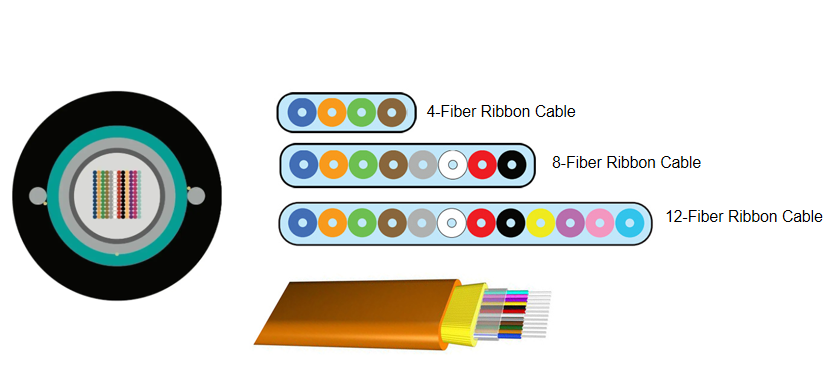
A ribbon cable consists of individual fibers aligned in a single row on the same flat strip, which explains its name ribbon cable or flat ribbon cable. Each ribbon typically contains 4, 6, 8, 12, or 24 fibers, and individual fibers within the ribbon are color-coded for identification following the TIA-598 standard. It offers higher fiber counts and greater fiber density than any other cable construction designed for the outside plant (OSP), up to four times the maximum fiber count commonly available in loose tube cables. Ribbon cables also enable mass-fusion splicing, whereby each 12-fiber ribbon can be mass-fusion spliced in a single operation using dedicated ribbon splicing equipment. It facilitates fast network installation and restoration after cable cuts.

\

What are the Benefits of Using Ribbon Cable?
Efficiency and Cost Savings: Compared to loose tube fiber splicing, ribbon cable splicing is less time-consuming — approximately six times faster — reducing installation time and labor costs. For example, splicing a 144-fiber loose tube cable takes about 10 hours at a cost of roughly $3,600 per joint, whereas a 144-fiber ribbon cable reduces
Better Solution to Congested Pathways: CSP (Communication Service Provider) can better leverage existing conduits and ducts for future fiber expansion by using ribbon cables. The small footprint of ribbon cables provides a better solution to congested pathways and conduits.
More Closure Flexibility: Ribbon cables are versatile and can be applied in the same closures as loose tube cables using a ribbon splice tray.
Reduction of Splicing Error Rates: A 144-fiber ribbon cable (12 ribbons × 12 fibers each) requires only 12 mass-fusion splices — dramatically lowering the possibility of an error. The reduction of splicing error rates also translates into more time efficiency.
Quicker Time to Restoration: Failures caused by fiber cut disruption can be catastrophic, mainly for businesses and customers. With ribbon cable, CSPs can restore services significantly faster to mitigate revenue loss and improve the customer experience.
Quicker Time to Market: The time savings for using ribbon cables over loose tube cables are tangible. That time savings directly contribute to a quicker time to market, helping better achieve business goals.

Application Scenarios
The ribbon cable is widely used in data centers, core networks, MAN/LAN, CATV, avionics networks, backbone networks, FTTH networks, fiber optic distribution boxes, MTP/MPO connectors, fiber splice closures, cabinets, and pedestals, etc.


\

Conclusion
In summary, the ribbon cable offers high crush resistance, tensile strength, fiber counts, fiber density and bandwidth, and mass fusion of fibers. Adding ribbon cable into your data center cabling strategy enables businesses to meet competitive challenges and to better cash in on current and future market aspects.

Sun Telecom specializes in providing one-stop total fiber optic solutions for all fiber optic application industries worldwide. Contact us if you have any needs.


Position : Home >Products

Related News

Fiber Optic Ribbon Cable, Do You Know About It?

As we see the demands of high bandwidth double the need for...

Learn More