Gigabit Ethernet and Fast Ethernet switches are network switches used in LAN (Local Area Network). These switches are designed to facilitate data communication within a network by allowing multiple devices to exchange data concurrently. What is the difference between them? Find the answer in this article.
Gigabit Ethernet Switch vs. Fast Ethernet Switch: What are They?
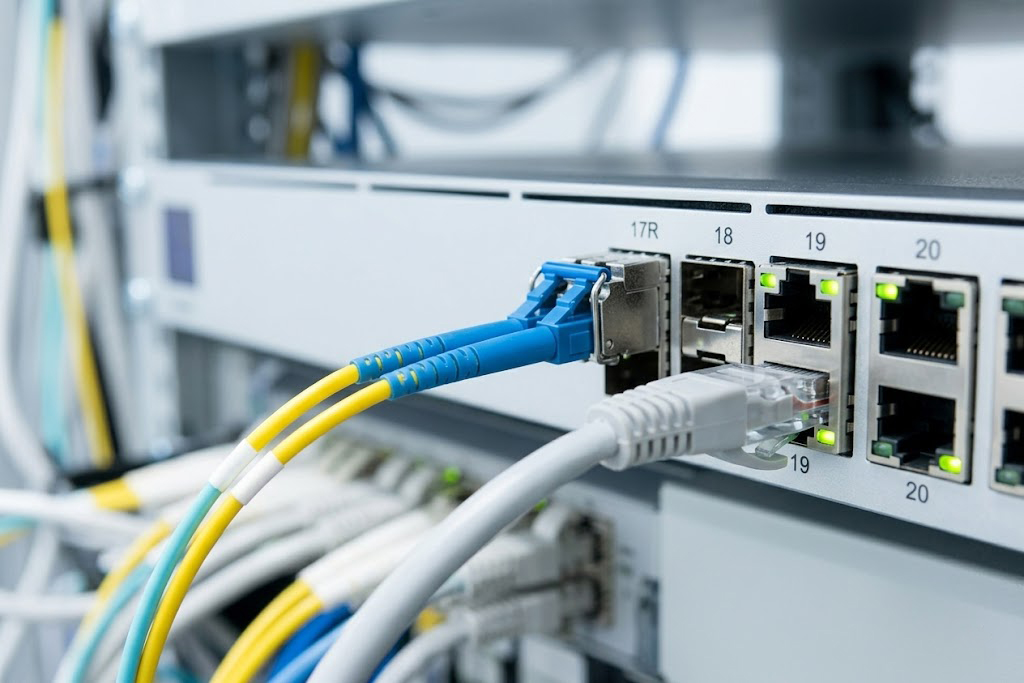
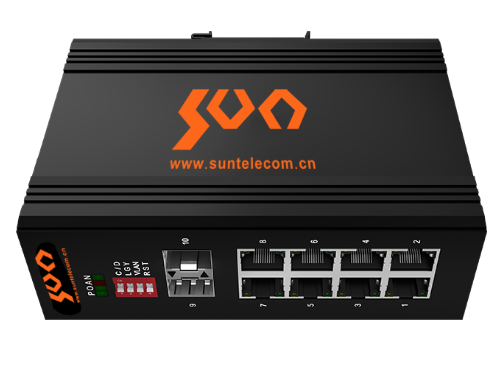
A Gigabit Ethernet switch is an Ethernet network switch that allows devices to connect to a LAN at speeds up to 1 Gbps. It delivers 1000Mbps on each of the RJ45 or SFP ports on the switch. In addition, it has 8/16/24/48 port options, supports 10/100/1000BASE-T Ethernet, and works well with copper cables and SFP optical transceivers.
Fast Ethernet switch is similar to Gigabit Ethernet switch, but provides a transmission speed up to 100 Mbps, providing relatively modest data forwarding capability.
Gigabit Ethernet Switch vs. Fast Ethernet Switch: What is the Difference?
1) Data transmission speed: Gigabit Ethernet switches can transmit data speeds up to 1000 Mbps to gigabit networks, while Fast Ethernet switches support data transmission speeds of up to 100 Mbps.
2) Delay: A Fast Ethernet switch typically exhibits store-and-forward latency in the range of tens to hundreds of microseconds, depending on the model and features. A Gigabit Ethernet switch generally offers lower latency due to the shorter serialization delay at higher speeds (e.g., the bit time of Gigabit Ethernet is 1 ns, compared to 10 ns for Fast Ethernet). Therefore, the Gigabit switch delivers better delay performance overall.
3) Cost: A Fast Ethernet switch provides a lower cost than a Gigabit Ethernet switch. This makes it an attractive option for home networks and small businesses that need a reliable network connection without incurring a high cost.
4) QoS (Quality of Service): Gigabit Ethernet switches typically have more advanced QoS features that allow better network traffic management and prioritization of certain types of data, which are typically more limited or entry-level on Fast Ethernet switches.
5) Application: Gigabit Ethernet switches are commonly used in enterprises due to their high internet speed, forwarding capacity, security, and efficiency. A Fast Ethernet switch has the benefit of low cost, and the configuration is relatively simple and easy to operate, which has become the ideal choice for small businesses and home applications.
Conclusion
Gigabit Ethernet switches support data transmission speeds of up to 1000 Mbps, while Fast Ethernet switches support data transmission speeds of up to 100 Mbps. However, Fast Ethernet switches typically feature lower cost and, in their most common unmanaged variants, simpler configuration than Gigabit Ethernet switches.
Sun Telecom specializes in providing one-stop total fiber optic solutions for all fiber optic application industries worldwide. Contact us if you have any needs.





 Position :
Home>
News & Tutorial
>Products
Position :
Home>
News & Tutorial
>Products







 ics@suntelecom.cn
  +86 18964888554
 Building No.145, Lane 666 Xianing Road, Jinshan Industrial Zone, Shanghai 201506, China




 +86 21 60138638


